
|
|
|
| Abbess, Christian Orthodox Abbot, Christian Orthodox Accountant Acting Official Adjutant General Admiral Admiral, Texas Navy Adventist Minister Alderman Archbishop, Catholic Archbishop, Christian Orthodox Archdeacon, Episcopal Archimandrite Architect Archpriest Ambassador to the U.S. from a foreign country Ambassador of the U.S. American Indian Chief Assemblyman U.S., State / or Assemblywoman Associate Justice, U.S. Supreme Court Associate Justice of a State Supreme Court Astronaut Attorney Attorney General Attorney General, Assistant Attorney, U.S. Australian Officials
Baron, Baroness British Officials, Royalty, Nobility Brother, Catholic Brother, Christian Orthodox Bishop, Catholic Bishop, Christian Orthodox Bishop, Episcopal Board Member Boy Brigadier General Business Cards
Canadian Officials Candidate Captain, USA, USAF, USMC Cardinal Chairman Federal Reserve Chairwoman Chancellor Chaplain in the Armed Services Chaplain of Congress Chargé d’Affaires Chief Executive Officer Chief Judge Chief Justice, U.S. Supreme Court Chief Justice, of a State Supreme Court Chief of Police Chief of Staff Chief Operating Officer Child Chiropractor City Manager Clergy & Religious Officials Club Official Colonel, Kentucky Colonel, USA, USAF, or USMC Commandant Commissioner, Court Commissioner Commodore of a Yacht Club Congressman, U.S. Congresswoman, U.S. Consul and or Consul General Consultant Corporate Executive Councilman Councilwoman Counselor (Diplomat) Countess County Officials Couples Curator
Dalai Lama Deacon Dean, academic Dean, clergy Deceased Persons Delegate, U.S., State Dentist Deputy Chief of Mission Deputy Marshal Designate, Elect, Pro Tempore Diplomats District Attorney Doctor, Chiropractor Doctor of Dentistry Doctor of Medicine Doctor, Military Doctor of Veterinary Medicine Doctor of Osteopathy Doctor, Other Disciplines Doctorate Doctorate, honorary
Earl Elect, Designate Pro Tempore Emeritus/emerita Eminence Emperor Engineer Etiquette Excellency
Family Fiancee Firefighter First, Second, Third, etc. First Lady, Spouse of the President of the United States First Lady, Member of Her White House Staff First Lady, Spouse of a Governor or Lt. Gov. First Lieutenant Flag Protocol Former Officials Freeholder
Gay Couple Geshe General USA, USAF, USMC Girl Governor General Governor, Lieutenant Governor, Lt., Spouse Governor, Tribal Council Governor, U.S. State Governor, Former Governor Spouse of Governor's Staff, Member of Governors, Board of
High Commissioner Honorable, The Honorary degrees Honourable, The Indian Chief Inspector General Interim Official Introductions Invitations Writing & Addressing Invitations Military: Writing & Addressing
Judge, former Judge of US City or US Count Judge, US Federal Junior, Senior, I, II, III, etc. Justice, Associate Federal Supreme Court Justice, Associate State Supreme Court
King Knight
Late, The (deceased persons) Lawyer Lesbian Couple Lieutenant Lieutenant Colonel, USA, USAF, USMC Lieutenant General, USA, USAF, USMC Lieutenant Governor
Major USA, USAF, USMC Major General, USA, USAF, USMC Man, business Man, social Marquess / Marchioness Married Women Marshal for a Judicial District, U.S. Mayor, U.S. City Mayor, Canadian City Mayor Pro Tempore Mayor, Vice Medic Minister, Protestant Clergy Miss Monk, Christian Orthodox Monsignor Most Reverend, The Mother Superior Mr. (Social) Mr. (Business) Mrs., Ms. (Use, Social Forms) Mrs. vs. Ms. Mr. & Mrs. / Couples
Name Tags Nobility, British Nobility, Other Nun, Catholic Nun, Orthodox Nurse Officer, Police Pastor, Christian Clergy Patriarch, Christian Orthodox Patriarch, Ecumenical Patriarch of Constantinople People with Two Titles Permanent Representative Petty Officer Pharmacist Physician PhD Place Cards Police Chief Police Officer Pope, Catholic Pope, Coptic Postmaster General Post-Nominal Abbreviations Presbyter, Orthodox President, corporate President of College or University President of a US State Assembly President (current) of the U.S.A. President (former) of the U.S.A. President of the U.S.A., spouse of President-elect of the U.S. Priest, Catholic Priest, Christian Orthodox Priest, Episcopal Prime Minister Principal Professionals & Academics Professor Pro Tempore, Elect, Designate Psychologist
Queen Rabbi Ranger, Texas Representative, U.S., Federal Representative, U.S., State Resident Commissioner Retired Military 1. Formula For How to Address 2. Q&A / Blog On Use of Rank by Retired Military 3. Q&A / Blog on How to Address Retired Military Reverend, The Right Reverend, The
Same Sex Couple School Board Member Second Lieutenant Secretary, U.S. Department, Member of the Cabinet Secretary of Defense, U.S. Secretary, Assistant Secretary General of the U.N. Senator, U.S., Federal Senator, U.S., State Senator, Canadian Senior, Junior, I, II, III, etc. Senior Judge Sergeant Sergeant at Arms Seventh Day Adventist Minister Sheriff Sister, Catholic Solicitor General Speaker of the U.S. House of Representatives. Specialist Spouse of the President of the U.S. Spouse of the Vice President of the U.S. Spouse of an Elected Official State Attorney Surgeon General Texas Ranger Town Manager The Honorable Tribal Officials Two Titles, Person With Under Secretary US Attorney US Federal Officials US State Officials US Municipal Officials
Venerable, The Veteran (not Retired) Veterinarian Very Reverend, The VFW Officer/Official Vice Mayor Vice President of the U.S. Spouse of the Vice President of the U.S. Vice President-elect of the U.S. Viscount and/or Viscountess Warrant Officer Widow White House Staff Woman, business Woman, social Yacht Club Officer
|
| |
|
|
|
| How to Address a Pastor The Reverend is a courtesy title that describes a person. As a courtesy title like the Honorable our Your Excellency it always precedes a full name. Sometimes The Reverend is shortened by some to Reverend (or Rev.) and used as an honorific like Mr./Mrs./Ms./Dr. before the name. This is not the most formal form, but is the preference in some congregations. If you know an individual pastor prefers simply Reverend (Name) -or- Rev. (Name) -- use it: it is always courteous to follow the preference of the individual. However, the forms I show below are the most traditional and formal. Forms for just about every other type of clergy is can be found here . -- Robert Hickey
How to Address a Pastor with a doctorate Envelope, official: The Reverend (full name) (Church) (Address)
Letter salutation: Dear Dr. (surname): How to Address a Pastor without a doctorate
Envelope, official: The Reverend (full name) (Church) (Address) Letter salutation: Dear Pastor (surname):
|
|
|
FYI, here is what's come in to the Blog that relates to this office/rank. For recent questions sent in, check out Robert Hickey's Blog. For specific offices/ranks, check out Robert Hickey's On-Line Guide.
| |
| How to Address a Pastor? I would like to send an African Methodist Episcopal Zion Pastor a letter requesting that my organization visit his church on a selected Sunday to close a weekend celebration of our anniversary. How should the greeting read? (for example, Greetings Rev---- in the name of the Father) is this appropriate of should I just say Dear Rev._________? -- Maryann Lee
Dear Ms. Lee: I give the best forms for protestant christian clergy on http://www.formsofaddress.info/Pastor.html Address him as "The Reverend (full name)" and "Pastor (surname)" as noted there. I have never encountered a member of the protestant clergy who did not like that form, unless they also hold a doctorate and prefer "Dr. (surname)" While many clergy use "Rev." like "Mr./Mrs./Ms" ... but not all do, and some object to shortening "The Reverend" down to simply "Rev.". So I suggest you not use "Rev. (Name)" unless you know it is his personal preference. -- Robert Hickey
Addressing Clergy as Pastor (Name) on a Mailing Label? I am preparing a mailing list for regular correspondence in the United States. I have a few protestant pastors to whom I will be sending periodic newsletters. All of them go by Pastor (first name). I noticed on your website concerning how to address clergy that you told everyone to use The Reverend when addressing envelopes. Since none of my pastor friends call themselves Reverend, I was wondering if it was permissible to address them as "Pastor (David Jones)" or "Pastor and Mrs. (David Jones)" instead of "Rev. and Mrs. (David Jones)". -- Jennifer (Desiring not to offend)
Dear Jennifer: You write .... "none of my pastor friends call themselves The Reverend" It makes sense that none of them call themselves The Reverend. The Reverend ... The Honorable ... and ... His Excellency ... are all courtesy titles used by others when addressing the person ... are not used by the person themselves. For example, if you write to your U.S. Senator he/she would be The Honorable (full name) ... but when they sign their name ... they don't use The Honorable as part of their name. I always suggest the most formal form of address ... which is the form to which I find the fewest people object. The most formal way to address an envelope to most a protestant cleric is: The Reverend (First Name) (Surname) Name of Chruch Address A letter's salutation is the same form of their name you would use in conversation: Dear Pastor (Surname) or if they have a doctorate: Dr. (Surname) and of course the Episcopalians use: Father/Mother (Surname)
You write .... All of them go by "Pastor (first name)" If you know them as Pastor (first name) ... then you are on a first name basis with them. I am not (so far) ... so I'd call them Pastor (last name) until they asked me to call them Pastor (first name) My mother's pastor likes to be addressed as Pastor Jim ... and I call him that so in conversation. But I'd still address mail to him as The Reverend James Ensor.
You write .... "Rev. and Mrs. (David Jones)" It is not unusual to encounter Rev. used as an honorific like Mr., Mrs., Ms. or Dr. ... such as in ... Rev. (Last Name) But it's a form I'd use only if I knew it is their personal preference. Many pastors don't like it ... and complain to me in e-mails about it all the time! The formal way to write the pastor and spouse who uses the same last name as the pastor .... would be to keep the person with the title's name as a unit and not mix it with their spouse's name: The Reverend David Jones and Mrs. Jones Address -- Robert Hickey How to Address Retired Protestant Clergy?
I’ve used your site several times recently and it’s extremely helpful. Thanks for providing such a comprehensive reference. My current questions: 1. How do you address protestant clergy? For example, do you still use “Rev.” or “The Rev. Dr.” to address a retired minister? 2. Does a person’s personal preferences matter in forms of address? For example, the minister mentioned above writes but uses no forms of address with his signature. When you respond, do you use his professional honorific or a standard like “Mr.”? -- Higgins Clinton
Dear Mr. Clinton,
Clergy continue to use "The Reverend" for ever. It never expires. I would always do the envelope formally: The Reverend James Wilson ... that form of his name is for the post office. Also there's a rule that in writing one does not give oneself an honorific .... so the minister not signing his name on a letter as "Pastor James Wilson" make sense. I don't sign my name "Mr. Robert Hickey" ... but that is how others would address me. Is that what you mean? I would formally address him in a salutation as something like "Dear Dr. Wilson" .... or if I was on a first name basis "Dear Jim" -- Robert Hickey How to Address a Female Pastor & Her Husband? How do I address a sympathy card to our female pastor and her husband on the death of her husband’s son from a previous marriage? -- nskcomstock
Dear nskcomstock, Most formally on an envelope your Pastor is listed first since she is The Reverend (Full Name) and he is a Mr. (Full Name). People with courtesy titles rank higher than people without them. And because she has a title ... she gets her whole name as a unit ... not mixed in with her spouse's name. So avoid anything resembling The Reverend Allyson and Mr. Wilson Smith... which is really bad. And assuming they use the same last name ... the most formal would be: The Reverend Allyson Smith and Mr. Wilson Smith In the salutation you could use the form you think she prefers in conversation .... Dear Pastor and Mr. Smith, Dear Dr. and Mr. Smith, Or if you are on a first name basis use: Dear Allyson and Wilson, -- Robert Hickey
How to Address the Husband of a Pastor? What is the proper title for a husband of a pastor? Would it be First Man? -- 3019881523
Dear 3019881523, What a pastor's husband would be called would be by the tradition of the congregation. But that said .... I have never encountered a congregation with a special title for the husband of their pastor. He would be Mr. or whatever honorific to which he is entitled. In my observation, among traditionally black protestant congregations they DO call officially call the wife of a pastor First Lady and they DO use the title as an honorific: In writing ... First Lady Nancy Smith In conversation .... First Lady Smith But .... I have never observed this pattern used in white protestant denominations. -- Robert Hickey | |
| How to Address a Pastor with a Doctorate? I need to mail something to my pastor, Rev. Calvin Cole who has received his doctorate - How do I address the envelope or even introducing him? -- Marsha Talltree Is is appropriate to use two titles together such as Rev Dr. The clergy and other staff at my church refer to our pastor as Rev. Dr. B. W. McClendon. He has a PhD and is also a Pastor of our church. -- Mrs. Brown
Dear Ms. Talltree and Mrs. Brown: The British style is to combine an use every honorific to which one is entitled. So British style books show names getting very l-o-n-g. The Reverend Dr. Wilson Smith The Reverend Professor Lord Wilson Smith His Excellency The Reverend Dr. Wilson Smith The Right Honorable Reverend Judge Lord Wilson Smith The US Style is simply to use one thing before a name or one thing after a name: The Reverend Calvin Cole The Reverend B. W. McClendon e.g., The Reverend Martin Luther King, Jr. So the one-thing-before-rule is why in the US you never see: The Honorable Dr. Calvin Cole General Dr. Calvin Cole Senator Mr. Calvin Cole In a salutation (and conversation) he's addressed with an honorific: Dr. Cole Dr. McClendon e.g., Dr. King NOTE: Sometimes clergy DO use simply Rev. as an honorific, preferring to be addressed as Rev. Calvin Cole ... On Monday of this week I visited an African-American Baptist church that uses Reverend (Name) for ordained clergy who preach but are not the pastor, and Minister (Name) for those who preach but are not ordained! I'd never seen that before, but they were very consistent within their community. My mother's Presbyterian pastor likes to be addressed as Rev. Bob, which is not precisely traditional, but of course I address him as Rev. Bob. But in writing I would use The Reverend Bob (Surname). -- Robert Hickey
How to Address a Pastor Who is Also a Chaplain? Regarding my pastor, who is also a military chaplain: I must write a sentence in our summer worship schedule for the church newsletter regarding the pastor's “Godspeed Celebration” we are holding before his deployment to Afghanistan. Which of these would be considered correct? Are any of them simply not correct at all? The Rev. (full name), chaplain of the ..., Indiana Army National Guard. The Rev. Lieut. Col. (full name), chaplain of the .... Lieut. Col. (full name), chaplain of the .... and pastor of .... Is there another form that would be more preferred? -- Lynn Harriman, Indianapolis
Dear Ms. Harriman, I think you are saying he is the pastor of your church ... AND he is also a chaplain? There is a tradition in American forms of address that we only give a person one title at time. ** As a chaplain he'd use the form I have on Chaplain Armed Services ** As you pastor he'd use the form I have on Pastor Your first option is the most formally correct for you at his church: The Reverend (full name), (degrees held) If it's a sentence you can include more information .. The Reverend (full name) is a Chaplain of the Indiana Army National Guard holding the rank of Lieutenant Colonel. And when he's on active duty with the National Guard they will use his chaplain form of address and note is also the pastor of your church. -- Robert Hickey
How to Address a Pastor and Her Military Husband? My question has to do with addressing envelopes. Our Pastor, Alyson Smith, of the Presbyterian Denomination, is married to a retired Lieutenant Commander, USN, Richard. He is to be awarded his PhD soon. Regardless of the degree, I have not been able to find out how one is to address an invitation, card, or letter to the two of them, together. --- Bobbi Sue Minton
Dear Ms. Minton: I have an entire chapter on joint forms of address in my book for just this type of situation. I am guessing you are addressing him socially, so ... socially his name is written: Lieutenant Commander Richard Smith As a member of the clergy, her name is written: The Reverend Alyson Smith
RANK WITH A POST-NOMINAL ABBREVIATION Regarding his PhD. In the US academic post nominals are never used with a rank. So he can be Lieutenant Commander Richard Smith (or Commander Smith in conversation) or Richard Smith, PhD (or Dr. Smith in conversation if he wants to be address as "Dr.") but never Lieutenant Commander Richard Smith PhD.
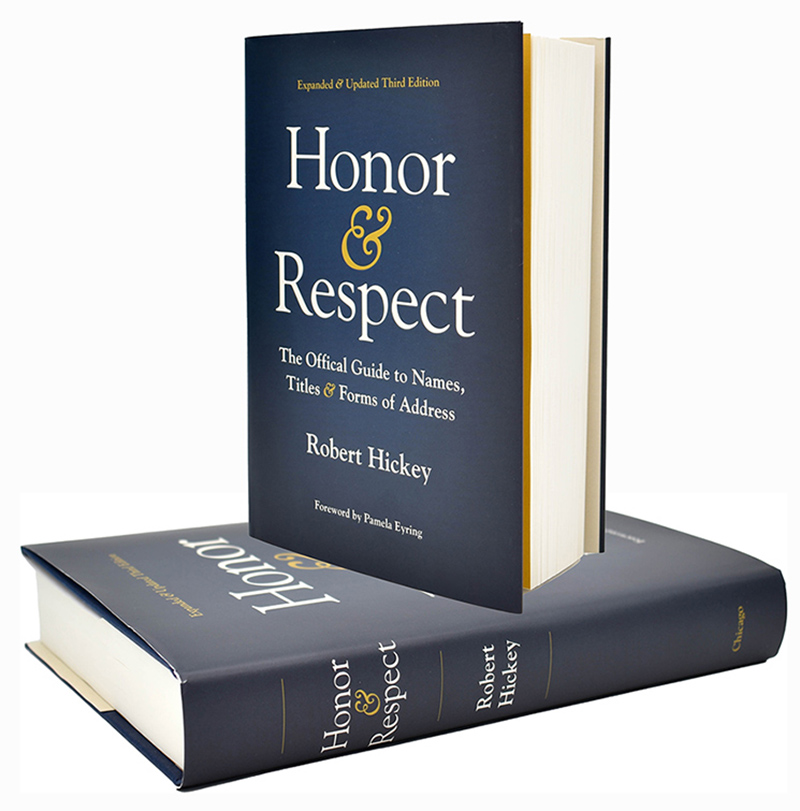
USE OF DOCTOR Usually holders of PhD's don't use Dr. (name) unless they work in academia or research. E.g., the holder of a doctorate in French who teaches would use Dr. (name) .... The holder of a PhD in finance who works at a bank wouldn't. But ultimately it's his option how he is addressed. WHOSE NAME IS FIRST? An active duty or retired military person has higher precedence than a civilian so is listed first. So in most circumstances the joint form would be: Lieutenant Commander Richard Smith and The Reverend Alyson Smith BUT if she is the invited guest ... and he is invited as her escort, then as the guest her name would appear first: The Reverend Alyson Smith and Lieutenant Commander Richard Smith I have spelled out "Lieutenant Commander" every time above, to avoid the whole issue of how to abbreviate his rank. I cover that in my book on pages 94-98 (service-specific abbreviations) if you need that information. -- Robert Hickey
| |
|
|
Not Finding Your Question Answered? Below are other topics covered in my blog and at right is a list of officials, Between the two I probably have what you are looking for. After hunting around a bit, if you don't see your question answered send me an e-mail. I am pretty fast at sending a reply: usually the next day (unless I am traveling.) If I think your question is of interest to others, I will post the question & answer – with your name and any personal specifics changed. -- Robert Hickey USE OF NAMES & HONORIFICS Mr., Miss, Jr., III, & Names Married Women Deceased Persons People with Two Titles Post-Nominal Abbreviations and Initials Couples: Joint Forms of Address (How to address a couple?)
USE OF SPECIFIC OFFICIAL TITLES Former Officials Professionals and Academics
United States Federal Officials, Currently In Office United States State Officials, Currently In Office United States Municipal Officials, Currently In Office All About The Honorable with U.S. Officials Former United States Officials of all types United States Armed Services, Active Duty Addressing Retired Personnel Use of Rank by Retired Personnel Use of Rank by Veterans
Tribal Officials Clergy and Religious Officials Canadian Officials Australian Officials British Officials, Royalty, and Nobility Diplomats and International Representatives Foreign National Officials and Nobility SPECIFIC SITUATIONS Business Cards Couples Etiquette Flags and Anthem Protocol Introductions Invitations: Writing & Addressing Invitations: Just Armed Service Personnel Name Tags Names on Programs, Signs, & Lists Naming a Building or Road Place Cards Plaques, Awards, Diplomas, Certificates Precedence: Ordering Officials Thank You Notes
Site updated by Robert Hickey on June 12, 2013
|
|
|
|
All information on www.formsofaddress.info is copyright © 2013 by Robert Hickey. The Protocol School of Washington® is registered in the U.S. Patent and Trademark Office. Honor & Respect is dedicated to Dorothea Johnson, Founder of The Protocol School of Washington®
|